

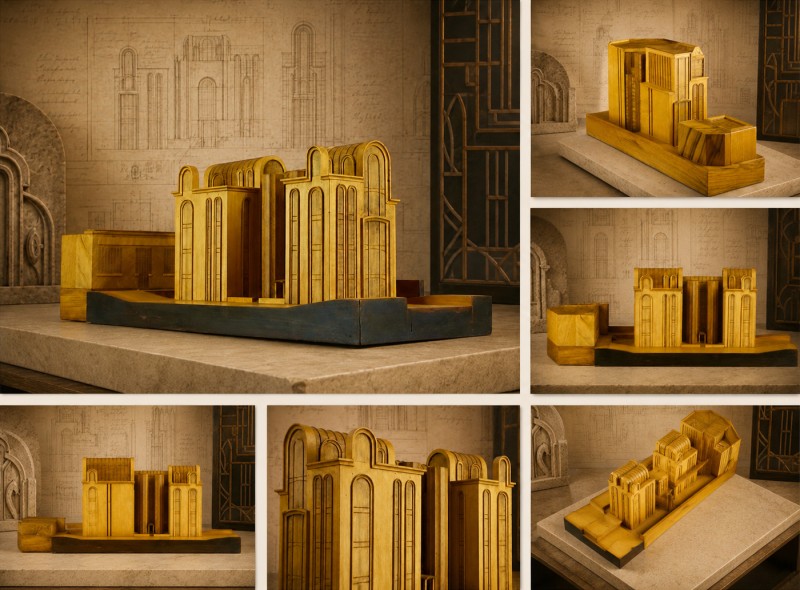
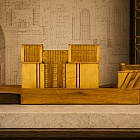
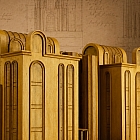
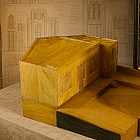
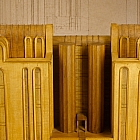
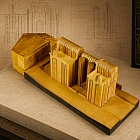
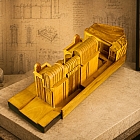
ATELIER ET MAISON DE JOSEPH BERNARD SCULPTEUR - PROJET EN BOIS DE 1921
Reduct models from PLUMET Charles
( 1861 - 1928 )
Joseph Bernard — 1866-1931
A major sculptor of the transition between Symbolism and Art Deco, renowned for his direct carving technique.
He settled permanently in Boulogne in 1921, at 24 Avenue Robert-Schuman, in a house-studio furnished by Charles Plumet with furniture by Ruhlmann. The entire property is listed as a historical monument.
Famous works:
The Dance;
Youth Charmed by Love;
Woman with a Pitcher;
Woman with Child
Joseph Bernard's studio in Boulogne, 1921. A major sculptor of the transition between Symbolism and Art Deco, renowned for his direct carving technique. He settled permanently in Boulogne in 1921, at 24 Avenue Robert-Schuman, in a house-studio furnished by Charles Plumet with furniture by Ruhlmann. The entire property is listed as a historical monument. Charles Plumet, Architect and Decorator
Charles Plumet (1861-1928) was a major French architect, decorator, and designer of the period between Art Nouveau and the beginnings of Art Deco. The National Institute of Art History lists him as an "architect and decorator," while the Musée d'Orsay holds several documents and works related to his work in the fields of architecture and decorative arts.
A champion of "art in everything"
In the 1890s, Charles Plumet worked closely with the decorator and cabinetmaker Tony Selmersheim. Together, they participated in the founding of the Group of Five, later renamed L’Art dans Tout (Art in Everything), alongside Alexandre Charpentier, Henri Sauvage, Jean Dampt, and Félix Aubert, among others.
This movement sought to abolish the separation between architecture, furniture, and decoration. The house was to be conceived as a total work of art, in which the building, furniture, ironwork, sculptures, and objects formed a coherent whole. This concept perfectly explains why Plumet could work with artists such as Joseph Bernard, Ruhlmann, and Raymond Subes.
Functional and Refined Architecture
Plumet championed architecture designed based on the use and needs of the inhabitants. Facades were to reflect the interior organization, light, orientation, and function of the rooms rather than mechanically reproducing academic models of the past.
His architecture is generally characterized by:
clearly articulated volumes;
facades enlivened by projections and recesses;
large openings adapted to the function of the rooms;
Bow windows, balconies, galleries, and terraces;
The decorative use of stone, wood, metal, and ceramics;
A gradual transition between the curves of Art Nouveau and the more restrained geometry of Art Deco.
Several Parisian buildings and private mansions are attributed to him, particularly in the 16th arrondissement. The Musée d’Orsay, for example, holds a detailed drawing of a stone balcony created in 1898 for a building on Avenue de Malakoff, now Avenue Raymond-Poincaré.
The 1925 International Exposition
Charles Plumet achieved recognition when he became chief architect of the 1925 International Exposition of Modern Decorative and Industrial Arts in Paris, the event that established the style that would later be known as “Art Deco” internationally.
In this capacity, he was responsible for the overall architectural organization of a significant portion of the exhibition. The Musée des Arts Décoratifs notably commemorates his role in the installation of the French Embassy, the prestigious pavilion of the Société des Artistes Décorateurs.
Charles Plumet and Joseph Bernard
In 1921, Joseph Bernard acquired a house located at 24 Avenue Robert-Schuman in Boulogne-Billancourt. The original house dated from 1880, but the sculptor's new studio was designed and furnished by Charles Plumet. The furniture was entrusted to Émile-Jacques Ruhlmann, while Raymond Subes was also involved in the ironwork.
Plumet therefore did not simply design a utilitarian building. He envisioned a true creative environment adapted to the work of a sculptor: ample space, natural light, easy flow between living quarters and studio, and the integration of the artworks into the architecture. The plaster cast of Joseph Bernard's famous Dance Frieze was notably preserved beneath the studio's cornice.
The house and studio, as well as the land on which they stand, were listed as Historical Monuments by decree of September 4, 2000. It is therefore preferable to write "the entire complex listed as a Historical Monument" rather than "classified as a Historical Monument."
The model is not simply an early representation of an artist's house. It documents the collaboration of three particularly important figures of the time:
Charles Plumet, for the architecture;
Joseph Bernard, for the sculpture and the intended use of the space;
Émile-Jacques Ruhlmann, for his furniture design.
Direct from the estate of the Joseph Bernard family.
Charles Plumet, architect of the project.
A major figure in French architecture and decorative arts, Charles Plumet (1861-1928) played a pivotal role in the transition between Art Nouveau and Art Deco. A co-founder of the L’Art dans Tout (Art in Everything) movement, he championed a holistic approach to living spaces, integrating architecture, furniture, sculpture, and decoration.
In 1921, Joseph Bernard commissioned him to design his home and studio in Boulogne-sur-Seine. Plumet conceived a space perfectly suited to the sculptor's work, in which the organization of volumes, light, and circulation directly addressed the needs of artistic creation. The furniture was designed by Émile-Jacques Ruhlmann, making this residence an exceptional example of collaboration between leading French designers of the early 1920s. Charles Plumet achieved recognition in 1925 when he was appointed chief architect of the International Exhibition of Modern Decorative and Industrial Arts in Paris, a seminal event in the Art Deco style. Joseph Bernard's house and studio are now listed as historical monuments.
FOCUS









WWW.MASTERPOSTERS.COM
By ESTAMPE MODERNE & SPORTIVE
7 RUE MILTON - 16 RUE CHORON 75009 PARIS
(+33) (0)1 42 80 01 03