

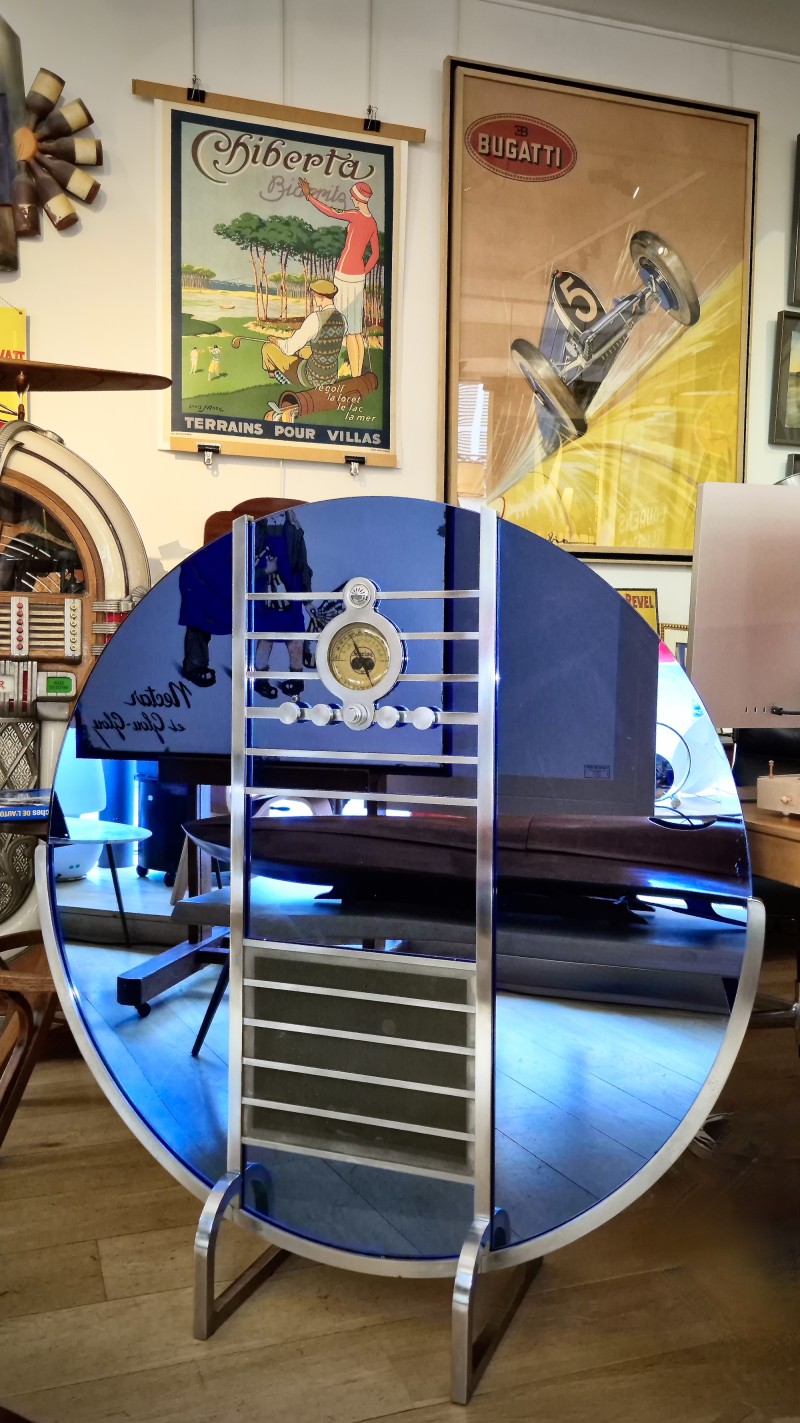
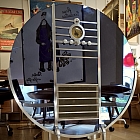
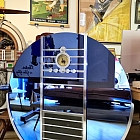
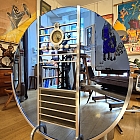
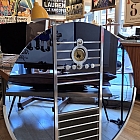
SPARTON RADIO MODEL 1186 NOCTURNE 1936
decorative objects from TEAGUE Walter Dorwin
( 1883 - 1960 )
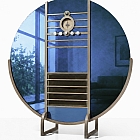
Sparton “Nocturne”, Model 1186
A large Art Deco radio console.
Designer / creator: Walter Dorwin Teague — American industrial designer, 1883–1960.
Manufacturer: Sparton Corporation / The Sparks-Withington Co., Jackson, Michigan, United States. Museums list it as a Teague design manufactured by Sparton.
Dimensions: The reference dimensions given by the Dallas Museum of Art are 46 × 43 × 12 in, approximately 116.8 cm high × 109.2 cm wide × 30.5 cm deep. LACMA gives a very similar width: 46 × 43 1/2 × 12 in, or 116.8 × 110.5 × 30.5 cm.
Some auction records give a greater depth, around 38.6 cm, probably depending on whether the feet and projecting elements are included in the measurement.
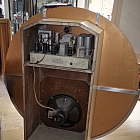
Materials: cobalt blue mirror / blue-tinted mirror glass, chromed metal or satin chrome-plated steel, painted wood or internal wooden cabinet.
History
The Nocturne was introduced for the 1936 model year, following its launch in the autumn of 1935. Sparton advertised it as a spectacular piece in “Midnight Blue” mirror glass and satin chrome. It belonged to a series of mirror radios designed by Teague, including the smaller Sparton Bluebird.
Its original price was around 350 dollars, an enormous amount during the Depression, almost comparable to the price of a car at the time.
This explains its very limited distribution: it was aimed primarily at highly luxurious interiors, hotel lobbies, elegant public spaces, or wealthy collectors.
Today, the design is considered one of the icons of the Machine Age and American Art Deco: a large blue mirrored disc, a geometric chrome structure, and a spectacular façade that transforms a technical device into an architectural object. The High Museum describes it as one of the most modern expressions of American design in the 1930s.
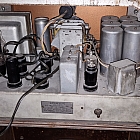
An important point for authentication: the Nocturne is Model 1186, with 11 tubes according to Sparton’s numbering logic. It should not be confused with the Bluebird 566, which is the much smaller table version.
To my knowledge, there is no confirmed official Sparton figure for the total production of the Sparton Nocturne 1186.
It is sometimes stated that around 24 examples were known at the time. However, the wording is important: this is not a factory archive, but a collectors’ estimate, and the publication itself specifies that the submitted information should be verified.
Market and museum sources remain more cautious. Artsy/Wright explicitly states that it is not known how many examples of the Nocturne were produced, because of its very high price and the fragility of the object. The Dallas Museum of Art also indicates that Sparton overestimated the sales potential of the model and that very few were made, without giving a total number. Sotheby’s currently refers to fewer than 25 known examples of this large floor radio, many of which have undergone restoration or replacement of the glass.
Total production: not officially documented. An older collectors’ estimate suggests approximately 85 examples, but this number is not confirmed by Sparton archives. Fewer than thirty examples are believed to be known today, often with restorations.
There is no official Sparton production register for the Nocturne 1186: no factory ledger, no list of serial numbers, and no table indicating “x examples produced.”
What can be found today consists mainly of:
Technical documentation / Sparton catalogues
Radiomuseum notes the existence of period Sparton documents — folders, service manuals, tube lists, bulletins — but this does not correspond to a production register by model or serial number.
Wright/Artsy clearly states that it is not known how many examples of the Nocturne were produced. This confirms that no official production figure has been publicly established.
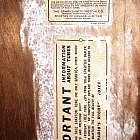
Visible plates do not necessarily provide a serial number
For example, Sotheby’s describes one example with an original plate “numbered 1186” — but 1186 is the model number, not proof of a production sequence number.
The Sotheby’s example also had glass dated “JUL. 31 1936,” which is an indication of manufacture, but not a complete production record.
No official Sparton production register for the Nocturne 1186 is currently published or known in accessible sources. The total production therefore remains undocumented.
To our knowledge, there is no complete public register of surviving Sparton Nocturne 1186 radios, with serial numbers and owners. There are only estimates and individual examples identified in museums, public sales, and private collections.
The most credible figure to use is: fewer than 25 known examples worldwide. Sotheby’s states that “less than twenty-five examples” are known, while specifying that many have re-silvered glass or replaced components. A 1993 source, Antique Radio Classified, already referred to approximately 24 known units.
Other sources give a lower figure, between 10 and 15 examples, but this seems to refer more specifically to examples circulating on the market or identified by certain European collectors, rather than all examples held in museums.
Approximately 20 to 25 examples are known or believed to survive, a significant number of them in museums; only around 10 to 15 appear to circulate on the market.
Publicly identified museum examples
Nocturne 1186 examples can be found in several institutions: the Dallas Museum of Art, LACMA, the High Museum of Art, The Wolfsonian–FIU, the Minneapolis Institute of Art, the Philbrook Museum, Die Neue Sammlung / Design Museum Munich, the Kirkland Museum, and probably the Milwaukee Art Museum for the very rare “old rose / peach” example that has been mentioned.
Auction records
I have found at least five public auction sales with clearly accessible prices, and probably six to seven sales if certain results reported by secondary databases are included. However, these do not necessarily represent five to seven different radios, as the same example may have appeared on the market more than once.
Number surviving: probably fewer than 25, often cited as between 20 and 25; only 10 to 15 would appear to circulate on the market.
Documented auction sales: at least five sales with confirmed public prices; approximately 10 to 12 auction appearances can be traced since 2003, including unsold lots and results that were not publicly disclosed.
These search criteria may interest you:
TEAGUE Walter Dorwin ART DECO DECORATIVE OBJECTSINDUSTRYFINISHED PRODUCTSMUSIC AND INSTRUMENTSRETROMOBILE SHOW JANUARY 2026ART DECO OBJECTSFOCUS






WWW.MASTERPOSTERS.COM
By ESTAMPE MODERNE & SPORTIVE
7 RUE MILTON - 16 RUE CHORON 75009 PARIS
(+33) (0)1 42 80 01 03