

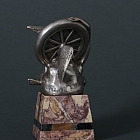
MASCOTTE AUTOMOBILE GERMAIN DE MELLANVILLE LE SAUVEUR
Car mascots from BOISSEAU DE MELLANVILLE Germain Louis Henri
( 1874 - 1915 )
Germain de Mellanville — The Saviour
The Sculptor
Germain Louis Henri Boisseau de Mellanville, known as Germain de Mellanville, was a French sculptor born in Paris on 9 November 1874. A pupil of the celebrated sculptors Alexandre Falguière and Antonin Mercié, he made his debut at the Paris Salon in 1897 and continued to exhibit there until 1912. He received an honourable mention in 1909 and a third-class medal in 1911. His career was tragically cut short by the First World War: serving as an infantry officer, he was killed in action in 1915 at l’Épine de Védegrange, in the Marne region.
The archives of the École Nationale Supérieure des Beaux-Arts also record him among the institution’s sculpture students of the early twentieth century.
His body of work includes portrait busts, Symbolist figures, Orientalist subjects and statuettes combining bronze, ivory and coloured marbles. Among his known works are the group Le Froid, exhibited at the Salon of 1904, a bust of General Galliéni presented in 1906, and the statue Sibylle, shown at the Salon of 1909.
He also produced models intended for the motorcar. Another mascot of his creation, entitled Securitas, is documented in silvered bronze, mounted on its original radiator cap, and was illustrated in an H.R. motor-accessories catalogue dating from 1924–1925.
Interpretation of the Subject
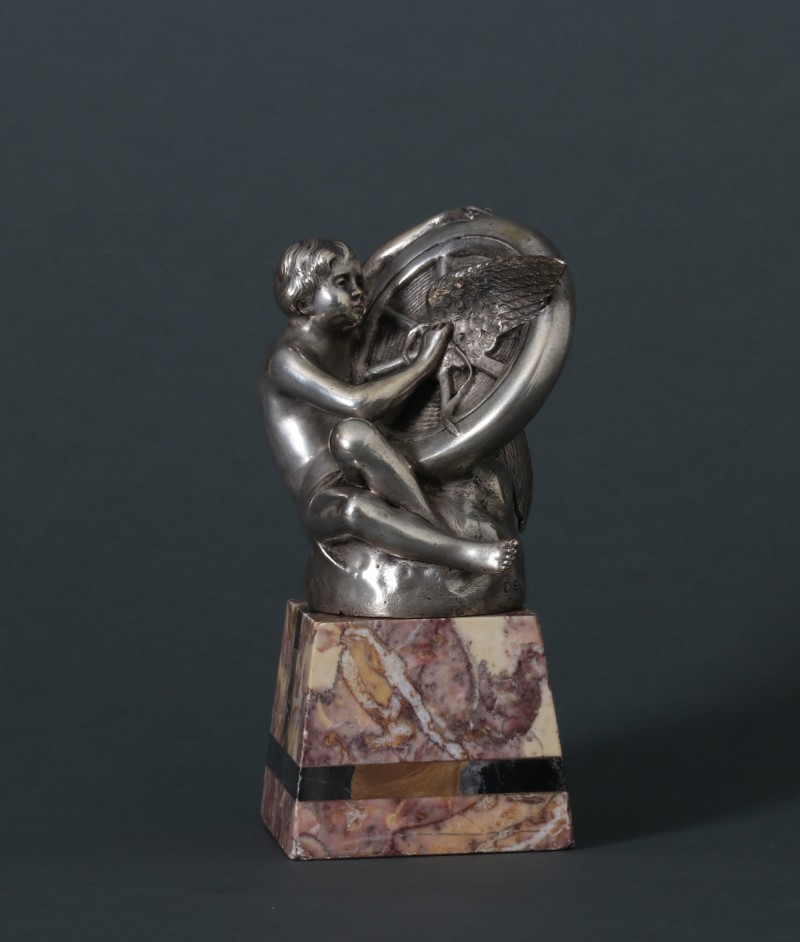
The sculpture depicts a child or protective spirit closely embracing a large winged wheel.
The winged wheel is one of the great symbols of the early motoring age, simultaneously evoking movement, speed, travel and mechanical progress. The child, whose body encircles and protects the wheel, brings a reassuring dimension to the composition. The figure may be interpreted as a guardian angel of the motorist, watching over the vehicle and its passengers.
The documented title, The Saviour, reinforces this interpretation: the mascot celebrates not merely speed, but speed placed under the protection of a benevolent spirit. Although the visible wings symbolically belong to the wheel, their positioning also transforms the overall composition into an almost angelic figure.
Proposed Dating
As the model was created by an artist who died in 1915, its conception must necessarily pre-date that year. I would therefore propose:
Model created circa 1910–1915
The silvered casting of this particular example may, however, have been produced or marketed slightly later. Its pyramidal base in polychrome marble, decorated with a highly geometric black-and-ochre frieze, is more evocative of the 1920s.
It would be important to inspect the underside of both the bronze and the base. An edition number, a foundry mark or traces of an earlier radiator-cap fitting could help to identify the precise edition.
Germain de Mellanville — The Saviour
Rare Silver-Patinated Bronze Motorcar Mascot
France, circa 1910–1915
Art Deco polychrome marble base, circa 1920
Artist: Germain Louis Henri Boisseau de Mellanville, known as Germain de Mellanville
Dates: Paris, 1874 – killed in action, 1915
Documented title: The Saviour
Material: silver-patinated bronze
Base: polychrome marbles with geometric black-and-ochre decoration
Signature: signed “de Mellanville” in the bronze
Dimensions: to be confirmed
Condition: very good condition, with an attractive patina and minor traces of use consistent with its age
Description
A rare and poetic motorcar mascot created by the French sculptor Germain de Mellanville, depicting a young protective spirit embracing an imposing winged wheel.
The model is now documented under the title The Saviour. An identical example, numbered beneath the base and mounted as a motorcar mascot, has been offered at public auction by Osenat.
The winged wheel, a universal symbol of movement and speed, was frequently used during the first decades of motoring. Germain de Mellanville gives the motif a more sensitive and expressive meaning: the child clings to the wheel, encircling it with his arms and legs as though protecting it. He thus becomes the symbolic guardian of the motorcar and its occupants.
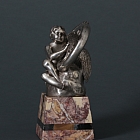
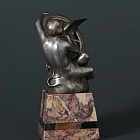
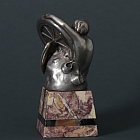
Viewed from the front, the composition reveals the child’s smiling face together with the powerful circular form of the wheel. At the rear, the wheel’s mechanical spokes are fully visible, framed by finely chased wings. This particularly elaborate three-dimensional design enabled the mascot to be admired from every angle when mounted on a radiator cap.
This example is distinguished by its highly elegant silvered patina and by its substantial architectural base in polychrome marble. The pyramidal construction of the base, emphasised by a horizontal black-and-ochre frieze, enhances the precious and decorative character of the sculpture while placing it firmly within the emerging Art Deco aesthetic.
Germain de Mellanville
A pupil of Alexandre Falguière and Antonin Mercié, Germain de Mellanville exhibited regularly at the Paris Salon between 1897 and 1912. Awarded distinctions in both 1909 and 1911, he produced portrait busts, Symbolist figures, Orientalist statuettes and sculptures intended for the decorative arts. His death in action in 1915 brought a promising career to a premature end.
A Rare Mascot from the Heroic Age of Motoring
At the crossroads of Symbolist sculpture, the decorative arts and automotive history, The Saviour is a particularly engaging work. Its rarity, protective iconography and remarkable polychrome marble presentation make it an exceptional piece for a collection of early motorcar mascots, automobilia or early twentieth-century sculpture.
These search criteria may interest you:
BOISSEAU DE MELLANVILLE Germain Louis Henri BELLE EPOQUECAR MASCOTSCARSRETROMOBILE SHOW JANUARY 2026FOCUS




WWW.MASTERPOSTERS.COM
By ESTAMPE MODERNE & SPORTIVE
7 RUE MILTON - 16 RUE CHORON 75009 PARIS
(+33) (0)1 42 80 01 03