



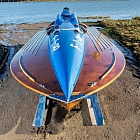
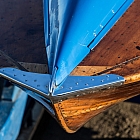
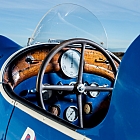
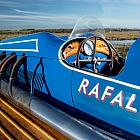
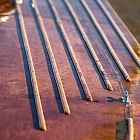
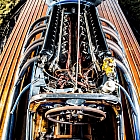
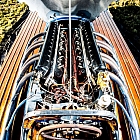

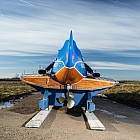
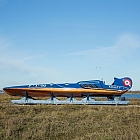
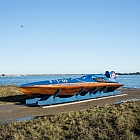
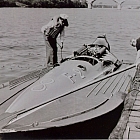
Maquette d’étude en bois du Rafale V Hydroplane de record Hispano-Suiza V12 — 1934 Étude de soufflerie pour le canot
Reduct models from ANONYME ANONYM
Wooden Study Model of the Rafale V
Hispano-Suiza V12 Record-Breaking Hydroplane — 1934
Wind-tunnel study model for the Rafale V racing powerboat, formerly Aurora
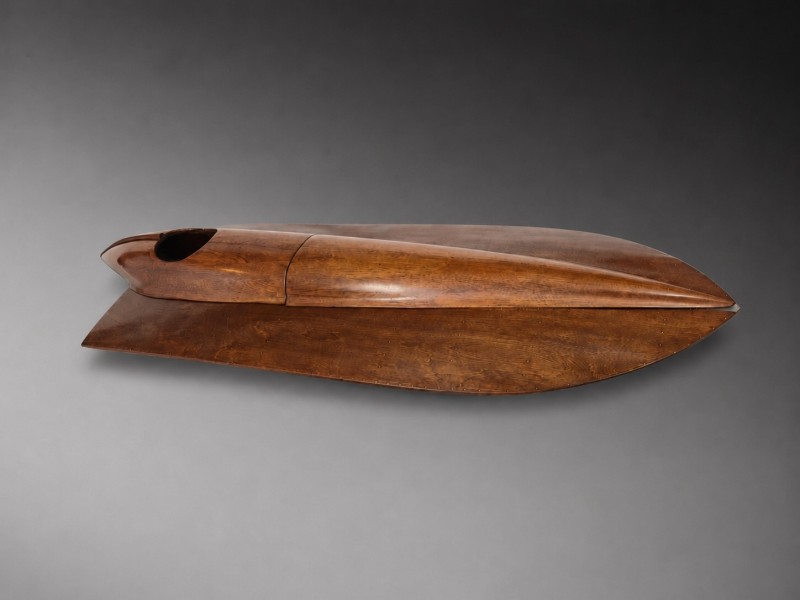
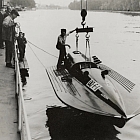
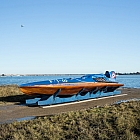
This exceptional wooden model, created in 1934, is a rare form study for the Rafale V, formerly Aurora, one of the most spectacular French hydroplanes of the interwar period.
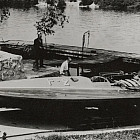
Commissioned by the industrialist and passionate yachtsman Émile Picquerez, and later owned by Commodore Gérard, the Rafale V was conceived as an unlimited-class racing powerboat, driven by an impressive 36-litre Hispano-Suiza V12 aircraft engine. Its final hull, built by the Chauvière boatyard in Vitry-sur-Seine, embodies a rare union of mechanical power, hydrodynamic research and Art Deco elegance.
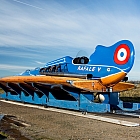
The present model bears witness to that technical ambition. With its exceptionally taut lines, faired cockpit, tapered bow and perfectly streamlined volumes, it reveals the attention given to studying the boat’s penetration through both air and water. More than a simple preparatory model, it appears as a true piece of engineering, intended to understand, control and refine the forms of a vessel designed for very high speed.
In the 1930s, the boundaries between aeronautics, record-breaking automobiles and powerboat racing were remarkably close. The Rafale V belongs fully to this world of pioneers, in which Hispano-Suiza aircraft engines, high-speed hulls and stability research gave rise to machines as daring as they were refined.
This wooden study also possesses remarkable sculptural power. Its low, streamlined silhouette, fluid modelling and precise execution perfectly express the aesthetics of speed characteristic of the interwar years. Here, function becomes form; performance becomes beauty.
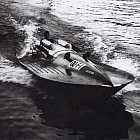
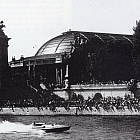
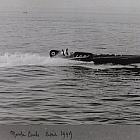
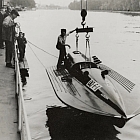
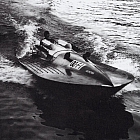
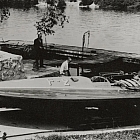
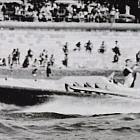
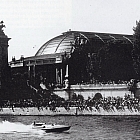
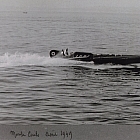
The final boat, then named Aurora, caused a sensation when it was presented to the public in 1935. In 1936, driven by Émile Picquerez himself, it won the Prix du Président de la République at the Cannes Semaine Nautique. It was later sold to Commodore Gérard, who modified it to improve high-speed stability, added a French tricolour roundel and renamed it Rafale V. The boat subsequently distinguished itself in speed events at Monte Carlo, Paris and on Lake Geneva.
Few objects bring together industrial history, scientific research, mechanical sport and formal elegance with such intensity. This study model of the Rafale V is not merely a witness to the birth of a record-breaking hydroplane: it is a precious fragment of the heroic age of speed.
Details
Object: Study model / wind-tunnel model
Subject: Rafale V racing powerboat, formerly Aurora
Date: 1934
Material: Sculpted and varnished wood
Purpose: Form study, aerodynamic and hydrodynamic research
Associated boat: Rafale V record-breaking hydroplane
Original commissioner: Émile Picquerez
Later owner: Commodore Gérard
Final hull by: Chauvière, Vitry-sur-Seine
Engine of the final boat: Hispano-Suiza V12, 36 litres
Period: France, interwar period
Style: Art Deco, aesthetics of speed, nautical engineering
Commentary
This model is a document of great rarity. It allows us to understand the Rafale V not only as a racing boat, but as the result of a genuine experimental process. The refinement of its line, the purity of its volumes and the tension of its profile all testify to advanced research into stability, lift and high-speed penetration.
It stands at the crossroads of several histories: the history of water-speed records, the history of Hispano-Suiza engines, the history of specialised French boatyards and the history of modern design in the 1930s. As such, it may be regarded at once as a technical object, an aerodynamic sculpture and a collector’s piece of great elegance.
These search criteria may interest you:
ANONYME ANONYMART DECOREDUCT MODELSNAUTISMSHIPSRETROMOBILE SHOW JANUARY 2026AUTOMOBILIAART DECO OBJECTSFOCUS




WWW.MASTERPOSTERS.COM
By ESTAMPE MODERNE & SPORTIVE
7 RUE MILTON - 16 RUE CHORON 75009 PARIS
(+33) (0)1 42 80 01 03