

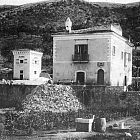
FONTE MEO ACQUA MINERALE NATURALE-AGNANI ( ROMA )
Antique vintage posters from NONNI Francesco Umberrio
( ITALIEN - ITALIE )
FONTE MEO – ACQUA MINERALE NATURALE – ANAGNI (ROMA)
Magnificent Original Italian Advertising Poster – Colour Lithograph – Circa 1910–1924
A remarkable composition from the golden age of Italian poster art, combining the elegance of Art Nouveau, the richness of colour and exceptional artistic virtuosity.
DESCRIPTION OF THE ARTWORK
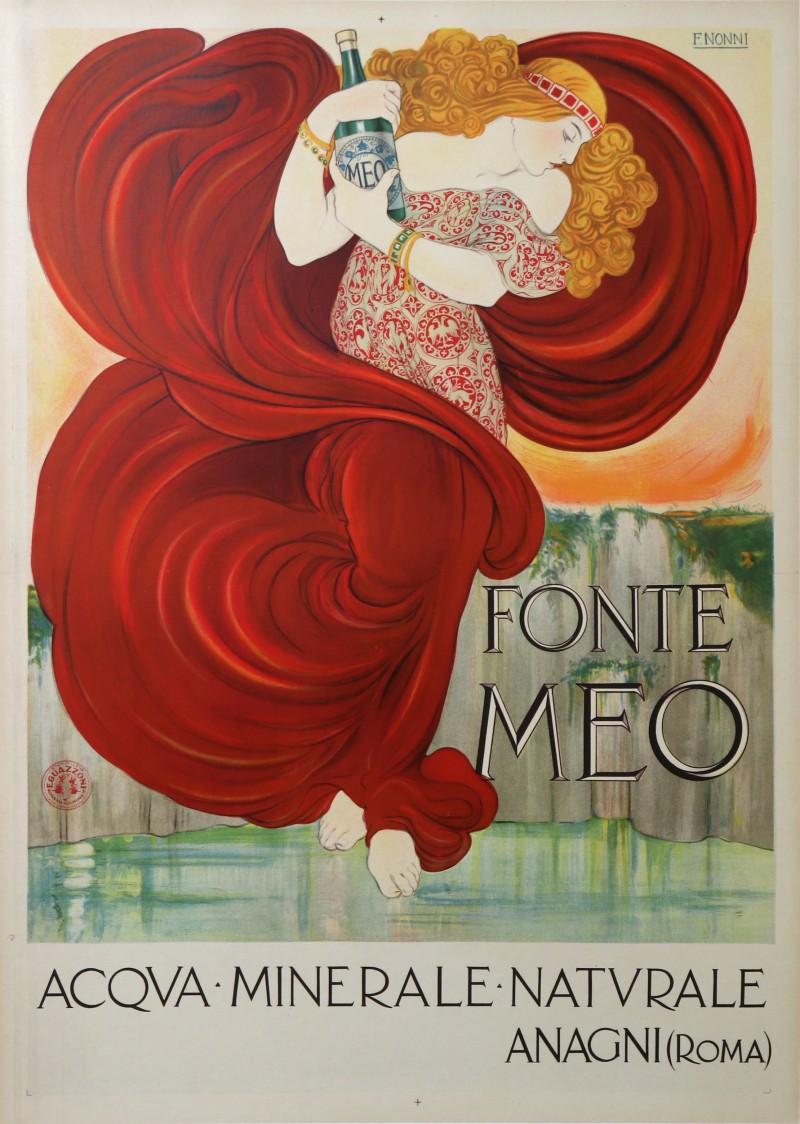
This spectacular advertising poster, created by the Italian artist Francesco Nonni, celebrates the natural mineral water Fonte Meo, originating from a spring located in the Anagni region, southeast of Rome.
Of extraordinary decorative power, this composition depicts a beautiful young woman with abundant golden curls, enveloped in a sumptuous vermilion-red drapery that appears to swirl dramatically around her.
Her silhouette, suspended in an almost aerial movement, evokes a dancer or an allegorical figure. She gracefully holds a bottle of Fonte Meo mineral water, its distinctive label forming the central advertising element of the composition.
The striking contrast between the deep red fabric, golden hair, delicate white complexion and the green and turquoise tones of the landscape gives this poster exceptional visual intensity.
In the background, a waterfall cascades into a pool of crystal-clear water, directly suggesting the natural origins and purity of the mineral water.
The treatment of the drapery, with its exaggerated folds and majestic curves, transforms this advertisement into a genuine work of art, standing at the crossroads of Symbolism and the Italian Liberty style.
The signature F. NONNI, printed in the upper right-hand corner, confirms the authorship of this particularly accomplished composition.
HISTORY OF THE FONTE MEO SPRING
The history of Fonte Meo is particularly fascinating and closely connected to the natural and archaeological heritage of the Lazio region.
The spring, also historically associated with the name Fonte Gabinia, is located within the municipality of Gavignano, approximately one kilometre from Anagni railway station and two and a half kilometres from the village of Gavignano.
According to historical research published by the local Pro Loco association of Gavignano, remains of an ancient Roman structure and water channels were discovered in this area during the 19th century.
The site is traditionally associated with a Roman estate believed to have belonged to the senator Aulus Gabinius.
In 1890, excavation work through the volcanic tuff revealed a narrow channel collecting water from the Meo spring, providing evidence of the long history of water collection at the site.
The commercial development of this natural mineral water subsequently expanded, particularly because of its natural qualities and reputation as a table water.
THE COMMERCIAL SUCCESS OF FONTE MEO
The commercial importance of Fonte Meo is documented in several official Italian publications.
An issue of the Gazzetta Ufficiale del Regno d'Italia, dated 27 August 1923, describes the marketing of the mineral water in Vichy-style glass bottles, as well as in larger ten-litre containers.
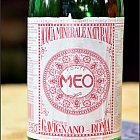
The bottles featured a distinctive blue-and-white label decorated with a circular motif inspired by a 16th-century Italian majolica design, with the name “Meo” prominently displayed at its centre.
Remarkably, this very label can be identified on the bottle held by the young woman in Francesco Nonni's poster.
This is a particularly interesting historical detail: the artist faithfully incorporated an authentic element of Fonte Meo's commercial identity into his composition, establishing a direct connection between the artwork and the history of the mineral water brand.
A HISTORIC SPRING RESTORED DURING THE BELLE ÉPOQUE
At the beginning of the 20th century, Fonte Meo entered a new period of development.
In 1907, the engineer Francesco Strocchi undertook an ambitious project to redevelop and enhance the spring.
The works included the construction of an underground gallery approximately 75 metres long, designed to channel the mineral water towards a specially constructed basin.
The spring was subsequently presented within an elegant decorative pavilion resembling a small classical temple.
Water flowed from three bronze taps positioned beneath a representation of Hebe, the Greek goddess of youth.
The entire complex was surrounded by a landscaped park planted with trees and flowers, giving the site the refined appearance of an elegant spa establishment.
This history provides an additional symbolic dimension to Nonni's poster.
The graceful young woman, depicted in a swirling movement of extraordinary vitality, may be interpreted as an allegorical representation of youth, freshness and the rejuvenating qualities associated with the mineral spring.
The spring continued to be commercially exploited throughout the 20th century.
From 1971 onwards, the waters from the Meo and Gaville springs were marketed under the name Gabinia, with distribution extending across much of the Lazio region.
FRANCESCO NONNI – A MASTER OF ITALIAN GRAPHIC ART
Born in Faenza on 4 November 1885 and deceased in the same city on 14 September 1976, Francesco Nonni was a remarkably versatile Italian artist, working as a painter, wood engraver, illustrator and ceramic artist.
From 1906 onwards, he participated in major Italian artistic exhibitions and notably exhibited at the Venice Biennale in 1910.
His reputation was particularly established through the exceptional quality of his wood engravings and his remarkable mastery of decorative composition.
In 1924, he founded the artistic journal Xilografia in Faenza, dedicated to the art of wood engraving, which he directed until 1926.
His artistic production reveals a sophisticated decorative sensibility, deeply influenced by the Italian Liberty style, Symbolist illustration and the traditions of Italian decorative arts.
The Fonte Meo poster perfectly illustrates these qualities.
Through its monumental composition, the extraordinary movement of the fabric and the harmonious richness of its colours, Nonni elevates a simple advertisement for mineral water into an artwork of remarkable artistic sophistication.
A MASTERPIECE OF ITALIAN ADVERTISING ART
With its impressive format, spectacular use of red, beautiful female figure and extraordinary richness of detail, Fonte Meostands as a remarkable example of early 20th-century Italian poster design.
The artwork belongs to the great European tradition of decorative advertising posters, a period during which commercial imagery became an independent and highly collectible art form.
The flowing drapery, almost sculptural in its treatment, creates a striking sense of movement and theatricality, while the delicate features of the young woman introduce a contrasting atmosphere of refinement and serenity.
The composition demonstrates Nonni's exceptional ability to combine artistic beauty with commercial communication.
Fonte Meo is consequently a particularly appealing and distinctive work for collectors of Italian vintage posters, Art Nouveau, Liberty-style graphic art and historic mineral water advertising.
These search criteria may interest you:
NONNI Francesco UmberrioART NOUVEAUANTIQUE VINTAGE POSTERSDRINKWATERS - SODASRETROMOBILE SHOW JANUARY 2026FOCUS




WWW.MASTERPOSTERS.COM
By ESTAMPE MODERNE & SPORTIVE
7 RUE MILTON - 16 RUE CHORON 75009 PARIS
(+33) (0)1 42 80 01 03