

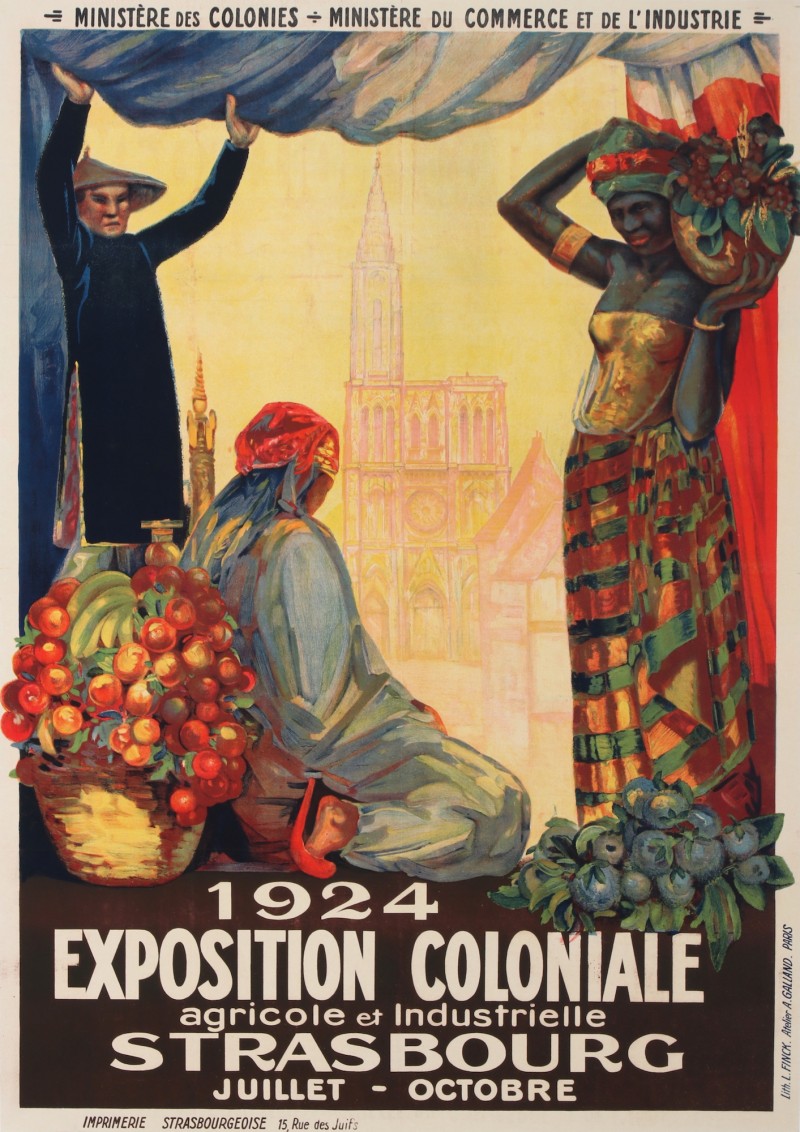
EXPOSITION COLONIALE STRASBOURG 1924
Antique vintage posters from ATELIER FINCK-GALLAND -
( XXe - XXe )
????️ Colonial, Agricultural and Industrial Exhibition of Strasbourg
6 July – 19 October 1924
Official title: Colonial, Agricultural and Industrial Exhibition of Strasbourg
Location: Parc du Wacken, Strasbourg, France
Dates: 6 July – 19 October 1924
Estimated attendance: approx. 1,000,000 visitors
Main organizers: Ministry of Colonies & Ministry of Commerce and Industry
Inauguration: Opened by Édouard Daladier, then Minister of Colonies
???? Historical Context
Following the First World War and the return of Alsace-Lorraine to France, Strasbourg sought to reaffirm both its place within the French Republic and its economic and symbolic ties to the colonial empire. The 1924 exhibition formed part of a series of major public events held in the city—following the National Exhibition of 1919 and the Pasteur Centenary in 1923—aimed at strengthening national identity and stimulating local economic activity.
????️ Objectives and Scope
The event pursued several objectives simultaneously:
???????? Strengthening National Unity
To demonstrate to the recently reintegrated regional populations of Alsace-Lorraine the role of the colonial empire within “Greater France,” reinforced by visual associations between Strasbourg Cathedral and France’s overseas territories.
???? Presenting the Colonial Empire
To bring together cultural, ethnographic, agricultural, and industrial elements from the French colonies (North Africa, Sub-Saharan Africa, Indochina, and Madagascar).
The exhibition featured spectacular reconstructions, including an “African village,” where individuals from colonized regions presented aspects of daily life such as craft practices, music, and staged scenes.
???? Economic Promotion
To highlight tropical products (coffee, cotton, spices, etc.), colonial trade opportunities, and the industrial prospects offered by overseas territories.
????️ Organization and Layout
The exhibition was divided into three main sections:
-
Local section (Alsace-Lorraine): showcasing regional industries and craftsmanship
-
Metropolitan section: presenting French industry, agriculture, and crafts
-
Colonial section: dedicated to the products and cultures of the colonial empire
Architecture and Pavilions
-
An Indochinese-style entrance gateway topped with a large decorative dragon
-
Construction of around twenty buildings and pavilions inspired by colonial architectural styles (Moroccan souks, Sudanese tata structures, Indochinese pavilions)
-
Pavilions dedicated to Algeria, Morocco, French West Africa (A.O.F.), Madagascar, and Indochina
???? Activities and Events
The exhibition extended well beyond static displays:
-
Official opening on 6 July 1924 by Édouard Daladier
-
A highly popular flower parade (corso fleuri)
-
Agricultural Week of Alsace and Lorraine
-
Professional congresses, livestock exhibitions, popular entertainment, and fairground attractions
Prominent political figures of the period, including Marshal Lyautey and Albert Lebrun (former Minister of Colonies), visited the exhibition.
???? Outcome and Legacy
The event attracted nearly 1 million visitors and brought together approximately 2,000 exhibitors.
It played a key role in establishing the Wacken exhibition grounds as a lasting venue for major events in Strasbourg.
Cultural Legacy
The exhibition remains a significant symbol of post-war relations between Alsace and France, while also reflecting the colonial representations and imaginaries of the period—now studied by historians to better understand metropolitan perceptions of colonialism.
These search criteria may interest you:
ATELIER FINCK-GALLAND -ART DECOANTIQUE VINTAGE POSTERSCOLONIALORIENTALISM and AFRICANISMHISTORYPROPAGANDARETROMOBILE SHOW JANUARY 2026FOCUS






WWW.MASTERPOSTERS.COM
By ESTAMPE MODERNE & SPORTIVE
7 RUE MILTON - 16 RUE CHORON 75009 PARIS
(+33) (0)1 42 80 01 03