

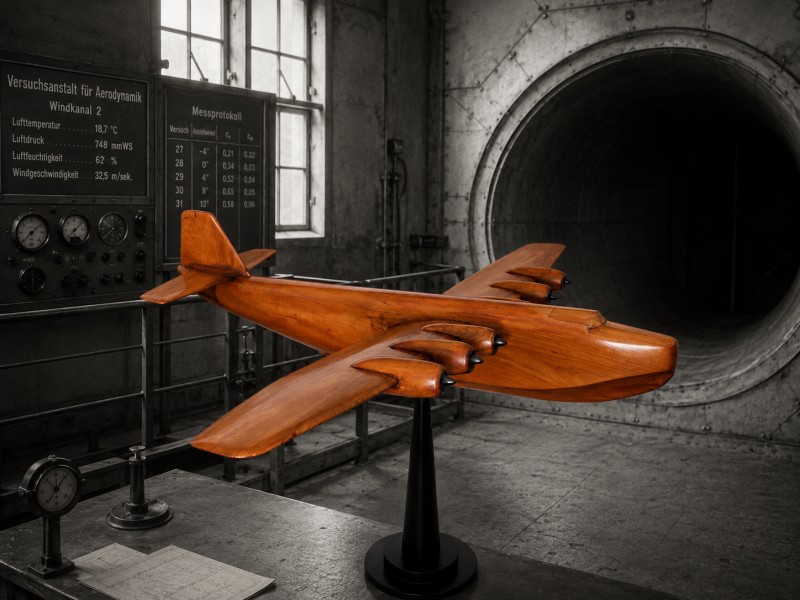
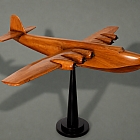
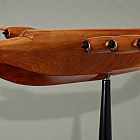
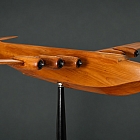
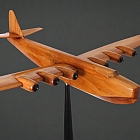
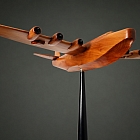
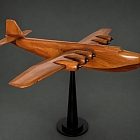
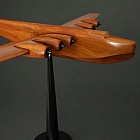
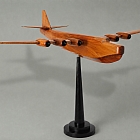
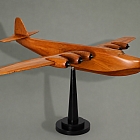
BLOHM & VOSS BV 222 « WIKING » — HYDRAVION HEXAMOTEUR MAQUETTE D’ÉTUDE AÉRODYNAMIQUE ALLEMANDE
Reduct models from ANONYME ANONYM
Six-Engined Aerodynamic Study Model
Germany, circa 1938
Wooden wind-tunnel prototype — Long-range transport aircraft project
Exceptional aerodynamic study model carved and polished from wood, representing a German six-engined aircraft project developed on the eve of the Second World War.
With its pure lines, slender fuselage and six propulsion units integrated into the wings, this model belongs to the world of wind-tunnel models produced for aerodynamic testing in German research institutes or in the design departments of major aircraft manufacturers such as Heinkel, Junkers, Blohm & Voss, Focke-Wulf and Dornier.
At that time, every new aircraft project was initially studied in the form of a wooden model. These models enabled engineers to analyse stability, lift, drag and overall performance before constructing a full-scale prototype.
This example displays a remarkable quality of execution: its volumes are perfectly balanced, the engines are carefully integrated into the wings, and the satin finish beautifully highlights the natural grain of the wood. Mounted on an elegant black conical stand, it is both a scientific object and a genuine modernist sculpture.
Historical Background
From 1936 onwards, Germany launched several studies concerning very large-capacity, long-range transport aircraft. Research was conducted in the wind tunnels of the major aircraft manufacturers, as well as in specialised institutes, with the aim of improving the aerodynamic performance of future civilian and military aircraft.
Many of these projects remained at the experimental stage. Industrial constraints, military priorities and the outbreak of the Second World War resulted in the abandonment of numerous highly promising studies.
Surviving wind-tunnel models are now extremely rare, as most were destroyed after testing or during the war. They bear witness to the extraordinary level of research achieved by the German aeronautical industry in the late 1930s.
A Historical and Decorative Object
Beyond its technical importance, this model possesses a remarkable sculptural presence. Its pure, streamlined design, characteristic of the 1930s Streamline aesthetic, makes it an exceptional decorative piece, naturally suited to a collection devoted to aviation, industrial design or the history of transportation.
Its elegance recalls the large presentation models produced for pre-war aeronautical design offices, which are now sought after by both museums and leading international collectors.
Blohm & Voss BV 222 “Wiking”
German Wooden Aerodynamic Study Model
Germany, circa 1938–1940
Attribution: Blohm & Voss BV 222 “Wiking”
Aircraft designer: Dr Richard Vogt
Type: Large six-engined, long-range transport flying boat
Model material: Carved, assembled and polished solid wood
Presentation: Important black conical stand
Description
Exceptional and imposing wooden aeronautical model representing a large German six-engined aircraft, most probably connected with the studies that led to the development of the Blohm & Voss BV 222 “Wiking”.
Entirely constructed from carved wood, it is distinguished by the remarkable fluidity of its fuselage, the impressive span of its wings and the regular arrangement of its six engine nacelles. The carefully polished surface reveals the natural grain of the wood and gives the model an almost sculptural quality.
The aircraft is displayed in flight on an elegant black conical stand. Its restrained and functional design evokes the technical models produced for design offices, aerodynamic testing or internal presentations by aircraft manufacturers prior to the construction of a full-scale prototype.
A Transatlantic Civil Aircraft Project
The history of the BV 222 began in 1937, when Deutsche Lufthansa sought a large flying boat capable of operating non-stop commercial services between Germany and North America, with a planned capacity of approximately 16 to 24 passengers.
The project was entrusted to the aeronautical division of the Blohm & Voss shipyards in Hamburg, whose technical department was then headed by engineer Richard Vogt. He designed an aircraft of considerable dimensions, equipped with a seaworthy hull, a vast high-mounted wing and six engines.
The aircraft was initially designated Ha 222, before becoming the BV 222 when the aeronautical division officially adopted the Blohm & Voss name. The archives of the Deutsches Museum notably preserve a record of correspondence sent in June 1939 by Richard Vogt to the editor of the aviation journal Flugsport concerning the BV 222. This confirms that the programme was already sufficiently advanced before the war to be the subject of a specialised presentation.
From Civil Transport to Military Service
The outbreak of the Second World War brought the transatlantic commercial programme to an end. The aircraft already under construction were subsequently adapted to meet the requirements of the Luftwaffe.
The first prototype, the BV 222 V1, made its maiden flight on 7 September 1940. The aircraft was then employed as a heavy transport plane, notably carrying personnel, equipment and wounded soldiers over long distances.
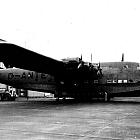
With a wingspan of approximately 46 metres and a length of nearly 37 metres, the BV 222 ranked among the largest operational aircraft of its period. A photographic notice in the Bundesarchiv describes it as the largest flying boat then operated by the Luftwaffe, powered by six engines producing a combined output of approximately 7,000 horsepower.
Depending on its version and mission, it could transport a large number of passengers, stretchers, freight or military equipment. Its immense hull incorporated several levels and enabled the loading of particularly bulky cargo.
Extremely Limited Production
Only thirteen examples are believed to have been completed, including prototypes and pre-production aircraft. The complexity of their construction, the quantity of materials required and the bombing of German industrial infrastructure severely restricted the programme.
The various BV 222 aircraft were deployed in several theatres of operation, notably in the Mediterranean, Northern Europe and along long-distance maritime transport routes. Several were destroyed in combat, scuttled or lost in accidents.
At the end of the war, a small number were recovered by Allied forces and briefly evaluated. No complete aircraft is preserved in a museum today.
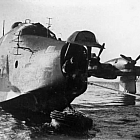
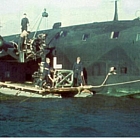
The wreck of the BV 222 V2 remains submerged in the Trondheimsfjord in Norway. Its rediscovery and identification have renewed awareness of the importance of this flying boat among the major German aeronautical programmes of the Second World War.
An Important Study Model
Wooden technical models played an essential role in aircraft development during the 1930s. They could be used to examine the general proportions of an aircraft, the arrangement of its mechanical components and its aerodynamic qualities, or to present the project to the manufacturer’s management and the commissioning authorities.
The present model may correspond to a preliminary stage of the programme, predating the final configuration of the BV 222. Certain differences in form, particularly around the hull and its hydrodynamic equipment, may be explained by its experimental nature or by the progressive evolution of the project.
In the absence of a maker’s mark, identification plate or directly associated archival documentation, the attribution to the Blohm & Voss BV 222 must nevertheless be expressed with caution. Its six-engined configuration, overall silhouette and presumed date make this identification particularly plausible, although it cannot be stated with absolute certainty.
A Sculpture from the Heroic Age of Aviation
Through its dimensions, exceptional quality of execution and the beauty of its naturally patinated wood, this model extends far beyond the category of a conventional scale model.
It represents, at once:
- a testimony to German aeronautical research on the eve of the Second World War;
- a remarkable example of Streamline industrial design;
- a rare technical sculpture devoted to one of the largest six-engined flying boats ever constructed.
Its monumental presence and elegant original stand make it a major piece for a collection devoted to the history of aviation, industrial models or twentieth-century design.
Specifications of the BV 222 “Wiking”
Manufacturer: Blohm & Voss, Hamburg
Designer: Richard Vogt
Maiden flight: 7 September 1940
Original purpose: Civilian transatlantic flying boat
Subsequent use: Heavy military transport and maritime reconnaissance
Powerplant: Six engines
Wingspan: Approximately 46 m
Length: Approximately 36.5 to 37 m
Height: Approximately 10.9 m
Production: Approximately 13 aircraft
Crew and capacity: Varied according to version and mission
Blohm & Voss BV 222 “Wiking” — Important German Wooden Aerodynamic Study Model, circa 1938–1940
German Six-Engined Flying Boat Project, Attributed to the Blohm & Voss BV 222 “Wiking” — Wooden Study Model, circa 1938–1940
FOCUS








WWW.MASTERPOSTERS.COM
By ESTAMPE MODERNE & SPORTIVE
7 RUE MILTON - 16 RUE CHORON 75009 PARIS
(+33) (0)1 42 80 01 03